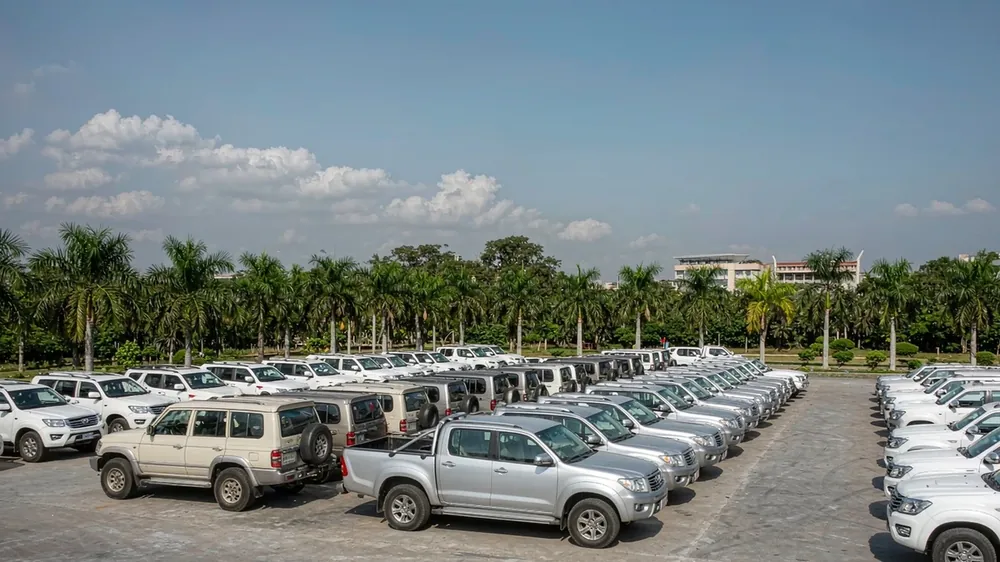
The structure of South Africa's imported light vehicles is being reset. The opportunity lies not in lower quotes, but in dealer networks and spare parts supply. In 2025, South Africa imported 391,287 light vehicles, up 28.6% year-on-year, of which India accounted for 219,796 units (56.2%) and China 91,326 units (23.3%), together nearly 80%. The share of Chinese brands in passenger cars rose from 11.2% in 2024 to 16.8% in 2025, and the number of brands increased from 8 to 15. Share is won, not waited for; the levers for winning share are network density, delivery cycles, and local inventory of common parts, not pushing vehicle quotes down another notch; a price war cannot build networks, but networks determine whether quotes are accepted by end customers. The price band is shifting downward faster than networks are being rolled out.
This round of change is not driven by a single factor. In 2025, South Africa's total new vehicle sales were 597,338 units, up 15.7% year-on-year, the best level since 2015; lower interest rates, improved credit availability, and pent-up replacement demand together brought consumers back to showrooms. What truly changed the landscape is the supply side: Chinese brands increased from 8 in 2024 to 15 in 2025, with another count claiming 18, accounting for nearly 40% of the total number of local light vehicle brands. In the first quarter of 2026, Chinese brands already accounted for more than 19% of South Africa's total new vehicle sales, with sales up 75% year-on-year, while passenger cars and light commercial vehicles overall grew only 12.7% in the same period. The meaning of these figures for importers is direct: the market is expanding, but the dividends of expansion are only realized by brands that already have service capabilities.
Looking at the price bands shows where the main battlefield is: about 64.2% of light vehicle transactions are below R500,000, and almost all new entrants are crowded below this line. Based on the 2025 import volume of 391,287 light vehicles, about 250,000 units fall in this range; if a dealer sells 600 units per year, this price band alone requires about 420 outlets with delivery and maintenance capabilities. Spare parts are the second constraint: each vehicle visits the shop an average of 1.5 times per year, occupying R2,000 in inventory per visit, corresponding to annual parts funding of about R750 million. These two constraints together show that victory in the main battlefield does not depend on the discount margin per vehicle, but on delivery capability and spare parts turnover speed below R500,000; whoever can extend networks into this price band will capture the increment.
For importers doing business in Southern Africa, channels determine how much share can be captured more than price. Indian vehicles account for 56.2% of import volume, relying on long-established entry-level networks and mature spare parts channels; Chinese brands use 23.3% of import volume to gain 16.8% of passenger car share, indicating that the products have gained a foothold. What is stuck next is store density, delivery cycles, and maintenance outlets. Continuing to push down vehicle quotes will only give gross margins to end customers without increasing the number of outlets. Indian and Thai vehicles have already formed stable spare parts channels in the entry segment. What Chinese brands need to capture is not these buyers' first car purchase, but whether they are still in the same showroom when they change cars for the second or third time. Once the service radius exceeds the distance customers are willing to travel, repeat purchases will shift elsewhere. What is truly scarce is people who can repair cars, parts that can be kept in stock, and warranties that can be honored.
Implementation actions can be broken down into three steps. First, request three sets of materials from suppliers: NRCS certification and COC documents for the target model, a list of common spare parts and their local procurement prices in South Africa, and the estimated voyage days for vehicles to Durban or Port Elizabeth. These three sets of materials correspond respectively to whether it can be legally sold, whether it can be repaired after sale, and how long funds must be tied up: if COC is missing a page, the entire batch cannot clear customs; if spare parts prices are not locked in, claims three years later will eat into current gross margins. Then plug these three sets of materials into the algorithm for single-store annual sales and spare parts occupation, confirm that regional exclusivity and after-sales training clauses are written into the contract, and agree on the maximum response days for spare parts replenishment. If you need to confirm the landed cost, certification cycle, and initial spare parts stocking amount for a certain model in the current market, you can provide the VIN, configuration list, and target delivery port to obtain a quote.
Message us on WhatsApp for the latest prices and delivery to your country.
WhatsApp us