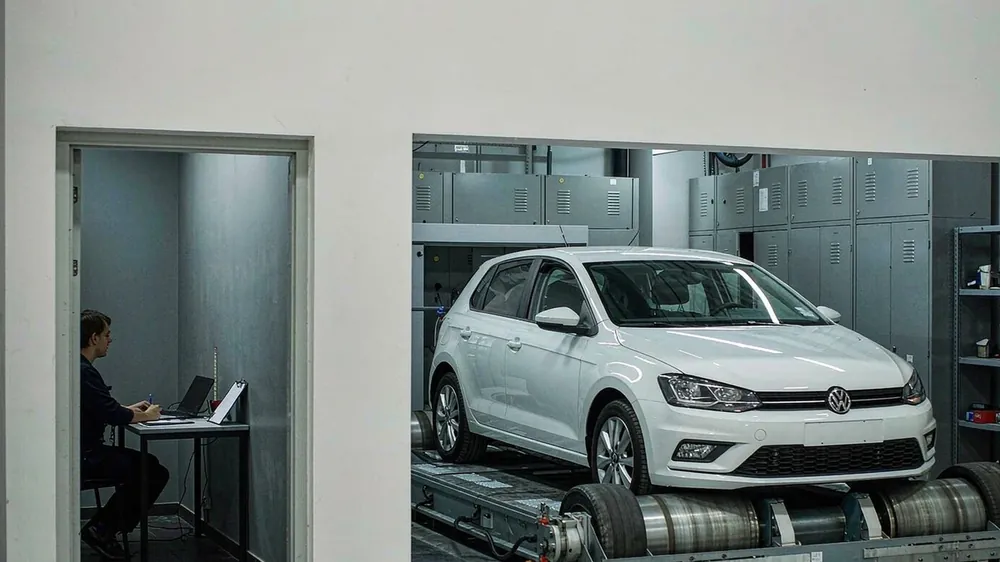
This time the EU has stuffed four new exam papers into whole-vehicle type approval: low-temperature battery electric range, electric drive system power, on-board battery durability, and brake particulate matter. The real signal is not that a few more tests have been added, but that the conclusions of these four tests must follow the vehicle all the way to the end user—registration, residual value assessment, and after-sales responsibility allocation all have to rely on them. For Chinese export models, if the procurement specification sheet does not include the test items now, the next round of production scheduling before the end of the year will have to be redone, and the cost of redoing it is not in the test fees, but in re-engineering, recalibration, and resubmitting samples. This round is not an environmental statement; it is a delivery date on the production schedule—a step late means shipping delays and empty showroom slots.
The EU Official Journal published Delegated Regulation (EU) 2026/1753 on September 24, effective the next day, inserting four independent test items GA19 to GA22 into the list of items in Annex II of Regulation 2018/858, covering M1 passenger cars, N1 light commercial vehicles, and special-purpose vehicles such as ambulances and motor caravans. The test methodology follows Euro 7: brake particulate matter is measured as PM10 according to the standard braking cycle, with a limit of 3 mg/km for battery electric M1 and N1, and 7 mg/km for plug-in hybrids, hybrid electrics, fuel cell, and pure internal combustion models; on-board battery durability looks at capacity retention rate, with M1 category required to be no less than 80% at 5 years or 100,000 km, and no less than 72% at 8 years or 160,000 km; low-temperature range is additionally tested separately in a -7 °C environment. Special-purpose vehicles may apply for an exemption, provided they prove they cannot meet the standards, and this must be marked on both the type approval certificate and the certificate of conformity; otherwise, leaving it blank on the certificate is equivalent to being unable to make a commitment.
The certification account must be calculated in three parts, and only the first part is visible. On the surface are the test fees: the four items are each independently established and independently concluded, and one vehicle cannot complete them all—low-temperature range goes into an environmental chamber, brake particulate matter must be run on a closed bench according to the cycle, electric drive power goes on a chassis dynamometer, and battery durability requires accelerated aging; sample submission changes from a single round in the past to multiple rounds, and bench scheduling itself becomes a critical path in the schedule. The second part is samples and logistics: multiple whole-vehicle samples travel back and forth to European laboratories, with freight, tariffs, and insurance all calculated on a whole-vehicle basis. The third part is the most expensive: if any item fails, changes will go back to the battery cell system, friction materials, or thermal management strategy, which is equivalent to pushing product development back a full cycle. What really weighs on delivery dates is not the testing itself, but the laboratory's bench scheduling; only by adding the three parts together can you get a model's true certification budget.
Also, do not pin all your hopes on replacing this with UN regulation certification. This amendment does indeed recognize that a set of UN regulations is equivalent to Euro 7A, but that only covers the entire block of exhaust and emission tests; on-board diagnostics, anti-tampering and cybersecurity, and on-board emission monitoring cannot find equivalent regulations in the UN system, and to replace them, the EU text for these items must first be completed. The special-purpose vehicle exemption is an exception loophole, but the exemption record will follow the vehicle to the end user, and second-hand buyers can see it just as well. When it hits importers, the certificate list changes from one sheet to a set: if the supplier only hands over a stack of UN certificates, the registration step will most likely be rejected, and every day weighs on an already locked shipping schedule.
Before placing an order, it is recommended to request four verifiable documents from the supplier: the EU type approval registration information corresponding to the four tests, the battery durability aging report, the brake particulate matter bench report, and the electric drive power measurement report, and write these into the contract as acceptance clauses, rather than verbal promises at the procurement meeting; at the same time, require the quotation to list the costs of the four tests and the number of samples submitted separately, to facilitate item-by-item price verification. If EU test conclusions are not available for the time being, at least obtain a written receipt of the bench schedule first; if any one of these four documents is missing, do not pay the deposit yet. To calculate the certification cycle and landed cost of a certain model under its current configuration, just send over the configuration list and VIN and a calculation can be provided.
Message us on WhatsApp for the latest prices and delivery to your country.
WhatsApp us