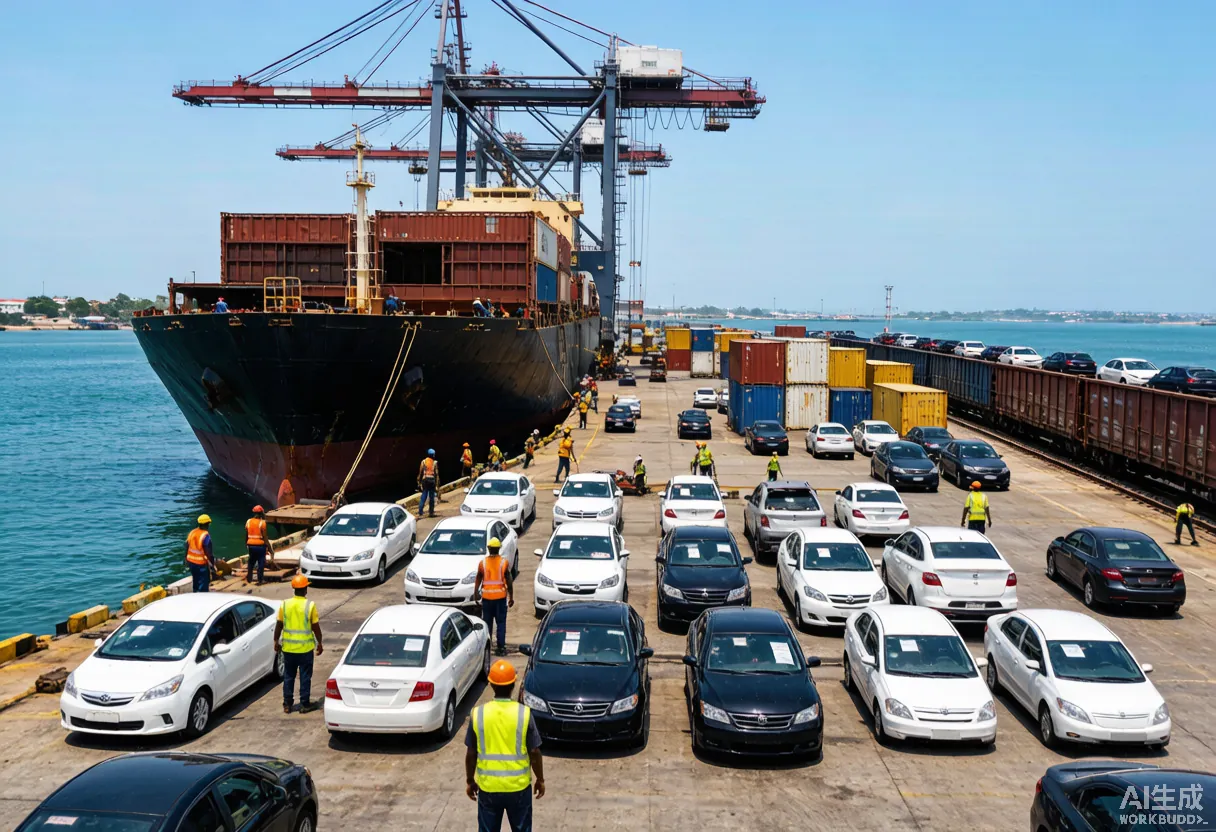
Several African countries adjusted their used-car import policies in 2026, and the direction runs against most people's intuition: tariffs generally came down, while age and emission standards tightened in parallel. Take Nigeria: announced by the presidency on April 13 and effective July 1, passenger-car import tariffs were cut sharply from 70% to 40%, while the age cap was tightened from 15 years to 12 years (10 years for commercial vehicles), the emission floor was raised to Euro 4, and a new vehicle recycling fund was added. Nigeria imports around 700,000 vehicles a year, with about 95% dependence on imports, so this adjustment has far-reaching implications for the region's vehicle mix — tariffs came down, but older cars became harder to bring in. The policy combination is designed to steer the market toward newer, cleaner vehicles.
Ghana has tightened its rules too: vehicles under 10 years old face no penalty, 10–12 years incur a 12.5% overage penalty, 12–15 years a 20% penalty, and anything over 15 years must be returned; from 2026, enforcement is carried out through AI-based customs verification. The minimum emission requirement is Euro II, and only left-hand-drive vehicles are permitted. As a counterbalance, used EVs under 8 years old enjoy zero tariffs (until 2032). Ghana imports around 100,000 used cars a year on average, with the Toyota Corolla ranking first in fleet size. Kenya, meanwhile, requires vehicles produced in 2019 or later (an 8-year limit) and is a right-hand-drive market — policy differences across countries are substantial: left- or right-hand drive, age limits, and emission standards all vary, so compliant supply must be verified country by country and cannot follow a one-size-fits-all approach. Exporters need to build a per-country policy ledger and update it dynamically, while closely watching the differentiated treatment of EVs, hybrids, and gasoline vehicles in each country and adjusting sourcing mix and pricing strategy accordingly.
For Chinese exporters, this is a clear window of opportunity: with age limits tightened, better-condition, newer-year Chinese used cars and new cars gain an edge over aging Japanese used cars. The data confirms the trend: in 2025, China exported 222,000 vehicles to Africa, up 67% year on year; Chinese used cars' market share in Africa rose from 1.2% in 2020 to 3.8% in 2024; and Ghana's imports of Chinese used cars jumped 384.9% in 2025. The market is shifting from "Japanese-only" attitudes toward acceptance of Chinese cars, and first movers will find it easier to build channels and reputation, with the first-mover advantages in sourcing organization and logistics compounding over time. As the licensing and procedures for Chinese used-car exports become standardized, the sourcing efficiency of formal export channels is improving, batch-delivery capability has grown markedly, and scaled operations are becoming feasible.
It is important to note that policies differ enormously across African countries: Nigeria is left-hand-drive, Euro 4, with vehicles under 12 years; Ghana is left-hand-drive, Euro II, penalty-free under 10 years; Kenya is right-hand-drive with an 8-year limit — compliant supply must be screened on a country-by-country basis, not one-size-fits-all. In addition, port clearance efficiency, exchange-rate volatility, and local payment habits directly affect landed costs and receivables cycles. A full end-to-end cost calculation is needed before purchasing to avoid the pitfall of "cheap landed price, expensive on-the-ground cost"; it is advisable to start with destination countries where clearance is mature and payment channels are stable.
EZ Auto can screen compliant vehicle supply according to your destination country's policies, and offer a comparison between "best-value Japanese used cars" and "Chinese-brand new cars with warranty." Contact us on WhatsApp and tell us your target market and budget, and we will provide matching supply and landed-cost estimates.
Source: Africa auto import bulletin

CPCA data shows Chinese self-owned brands took a 54.9% share of the Russian market in June, but with VAT raised to 22% and the scrappage fee rising to roughly 800,000-900,000 rubles, compounded by the taxi localization law, the era of effortless gains from complete-vehicle exports is over.
→ Read
On July 21, the Kazakh Prime Minister ordered the development of comprehensive measures to curb illegal car imports; the new customs enforcement and technical regulation measures must take effect from September 1, putting the gray channel of bulk personal-name imports on the path to a full shutdown.
→ Read
Effective July 1, 2026, Russia has once again raised the recycling fee coefficient for used cars by 18% to 25%. Combined with the cancellation of the low-rate personal import channel in April, gray-market space is being squeezed further, making compliant bulk imports by legal entities the mainstream channel.
→ ReadMessage us on WhatsApp for the latest prices and delivery to your country.
WhatsApp us