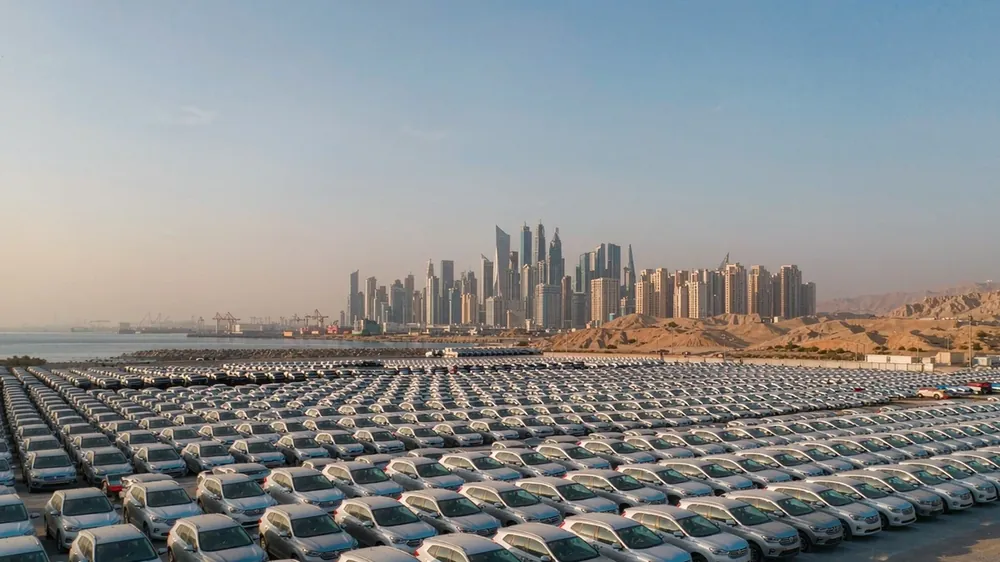
The real problem in Saudi Arabia is not the source of vehicles, but the dealer network that can deliver cars to after-sales service. In 2024, Saudi Arabia imported about 940,000 vehicles, and in 2025 about 960,000, totaling about 1.9 million over two years. China has ranked first among source countries for two consecutive years, while Japanese brands hold second place. For importers, the 10%–15% annual share growth comes from taking business from India, Thailand, South Korea, and even the US brands that have slipped to sixth place, rather than from new demand. Whoever first expands parts and service bays to secondary cities beyond Dammam, Riyadh, and Jeddah will capture this growth. The 1.9 million vehicle market does not lack demand; what it lacks is local service capacity to meet that demand; channel density determines whose books the money lands on. Gulf countries account for more than half of Saudi Arabia's vehicle sales, so network investments can be spread thinner.
The forces driving China's share upward come from both product and channel. A few years ago, Chinese cars in Saudi Arabia were regarded as an economical choice for a minority of buyers; now they compete head-on with Japanese and Korean brands in multiple segments. New energy vehicles are the main driver of recent growth, aligning with the sustainability goals of Saudi Vision 2030. Changes on the channel side are equally clear: local online car-buying platforms place Chinese cars' appearance, tech features, and extended warranties on the same comparison table as established rivals, making consumer judgment more objective. In ZATCA's data, China is first, Japan second, followed by India, Thailand, and South Korea, with the US sixth—a direct reflection of this shift in judgment. The two-year import volume of 1.9 million vehicles also keeps Saudi Arabia among the world's top 20 auto markets, and economies of scale lower unit logistics costs and make parts demand predictable.
According to the projections in the 2026 economic report, annual sales of Chinese brands in Saudi Arabia will exceed 120,000 vehicles. Distributing these 120,000 vehicles across a dealer network: assuming annual sales of 800 vehicles per store, about 150 outlets with both sales and after-sales capabilities are needed; for parts, assuming each vehicle visits the store 1.2 times per year on average and each visit ties up about $300 in inventory, about $43 million in parts capital must be held annually. If annual sales per store are only 500 vehicles, the same 120,000 vehicles would need to be spread across about 240 outlets, and the extra 90 locations mean site and labor costs multiply, while parts capital still requires about $43 million. The conclusion can be relayed directly to partners: whoever first expands outlets to secondary cities will capture the lion's share of these 120,000 vehicles.
For importers doing business in the Gulf, the opportunity lies in channels and after-sales, not in simply competing on price. The two-year market of 1.9 million vehicles shows that the market does not lack demand; what it lacks is local service capacity to meet that demand. Japanese brands hold second place, and Korean and Indian brands are also present. Price bands have already been squeezed very tight, and continuing to quote lower will only push oneself out of the profit zone. New energy is the main driver of recent growth, aligned with the sustainability goals of Vision 2030, so after-sales capability for charging and high-voltage systems becomes a screening criterion earlier than price. The standard can be simple: when the parts arrival cycle is longer than the vehicle delivery cycle, no matter how low the quote, repeat purchases cannot be sustained. What truly sets players apart are three things: predictable delivery cycles, local stock of common parts, and warranty terms that can be honored locally; these are exactly the first questions secondary dealers ask when screening new brands.
To turn opportunities into orders, first request three documents from suppliers: GSO/SASO conformity certificates and G-mark certification progress for target models, a list of common spare parts with local procurement prices, and estimated port arrival cycles for complete vehicles and SKD kits. Once obtained, recalculate based on annual sales of 800 vehicles per store and 1.2 store visits per vehicle per year to see if the sales threshold for regional exclusive authorization is reachable. The spare parts list should preferably be divided into three tiers by visit frequency, so that the local warehouse's minimum order quantity can match the turnover speed of 150 outlets. The contract should also specify after-sales training, the settlement currency and timeliness of warranty claims—don't leave the compensation pressure on your own books. If you need to confirm the landed cost, certification cycle, and initial parts stocking amount for a specific model in the current market, provide the VIN or configuration list to get a quote.
Message us on WhatsApp for the latest prices and delivery to your country.
WhatsApp us