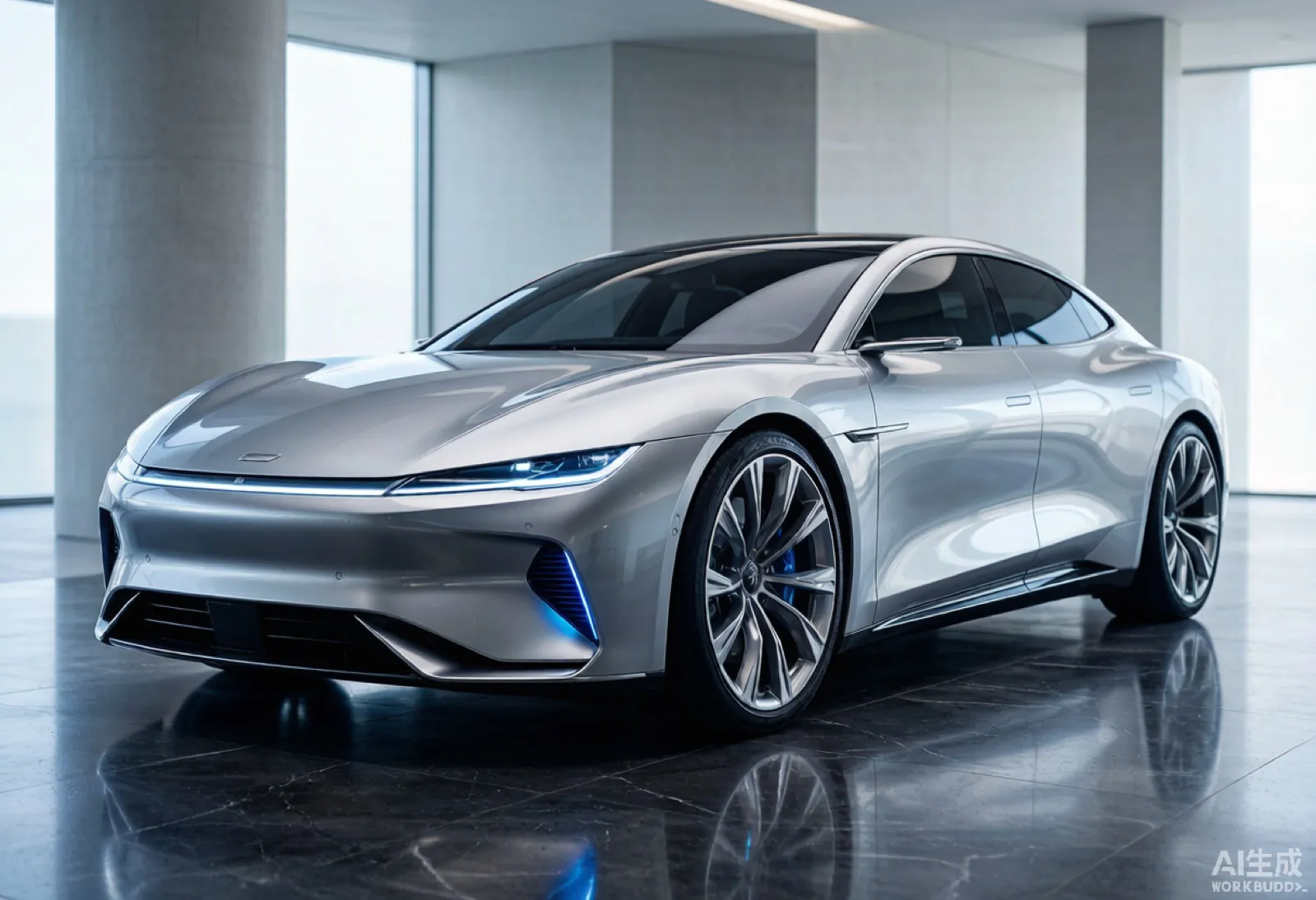
On August 3, Denza's new flagship sedan Z9S opened pre-sales at RMB 319,800 to 389,800, offered in three trims — Flash Charge Premium, Flash Charge Flagship and Yisifang Flash Charge Performance — with pre-order customers entitled to 18 months of free flash charging. All trims are equipped with a 102.326 kWh second-generation Blade battery, with maximum CLTC range of 1,100 km, setting a new global record for production pure-electric sedans; the company also announced flash charging that delivers "5 minutes to key range, 9 minutes to full charge," with charging time in -30 degrees Celsius environments only 3 minutes longer.
In March this year, the Denza Z9GT had just topped the world with a 1,036-km range; less than half a year later the Z9S surpassed itself at 1,100 km, a 64-km improvement. The bigger change is in the battery itself: the Z9GT achieved 1,036 km with a maximum optional 122.496 kWh battery, while the Z9S achieves 1,100 km with a smaller 102.326 kWh pack, thanks to the higher energy density of the second-generation Blade battery and optimized whole-vehicle energy consumption — the single-motor version consumes about 11.1 kWh per 100 km. Achieving ultra-long range with LFP breaks the industry's ingrained notion that "long range requires NMC," while retaining LFP's inherent advantages of low cost and good safety.
By the numbers: the Z9S offers three range tiers — 780 km (tri-motor all-wheel-drive), 920 km (single motor) and 1,100 km (single-motor flagship); flash charging is built on an 800V high-voltage platform with 4C-plus cells, charging from 10% to 70% in about 5 minutes and 10% to 97% in about 9 minutes. On performance, the tri-motor version delivers combined power of 890 kW, about 1,210 hp, with 0-100 km/h in 2.68 seconds; the body uses a steel-aluminum hybrid architecture, with high-strength steel and aluminum alloys accounting for 91.1% combined. BYD's supporting flash-charging network has surpassed 7,000 stations nationwide, with planned coverage radius of 3 km in tier-1/2 cities, 5 km in tier-3/4 and 6 km in tier-5/6; highway flash stations are planned to cover nearly a third of service areas, spaced about 100 km apart on average.
For overseas markets, mass production of the second-generation Blade battery means China's edge in range, charging and cost widens further: with higher energy density, the same battery weight travels farther, adaptation to heat and extreme cold improves, and the LFP route is cheaper and safer — well suited to the Middle East's heat, Central Asia's cold and emerging markets with thin charging infrastructure. Models carrying this technology, once exported, will directly challenge fuel cars and joint-venture EVs whose selling points are range and charging anxiety; consumers' concern that "EVs can't handle long trips" is greatly defused, and the market's pricing anchor shifts upward.
Importers are advised to add models with the second-generation Blade battery to their second-half selection lists and watch the pace and configuration differences of BYD-family models rolling out overseas. When marketing to end customers, use "1,100-km range, 9-minute recharge" as the core selling point, and calibrate real usage scenarios against the charging infrastructure in the target market to avoid exaggerated claims detached from reality. Also track certification progress of such models in target countries (e.g., EAEU СБКТС, GCC certification), lock in quotas and prices for compliant models early, and seize the first delivery window.
What does solid-state battery mean for Chinese vehicle exports?
Solid-state batteries promise longer range, better safety and lower weight — a key variable for NEV exports. EZ Auto tracks production progress and overseas certification fit in the News section to help buyers time model upgrades.
What to watch with ADAS features for export?
Advanced driver assistance involves local regulation and data compliance. EZ Auto recommends only the assistance levels already approved in the destination and labels feature boundaries, avoiding over-promising.
Are Chinese NEV charging standards usable overseas?
Charging connectors and voltages differ by country (e.g. CCS2 in Europe, GB/T in China). EZ Auto recommends compatible models for your market or suggests in-car adapters.
Does over-the-air (OTA) update work overseas?
OTA depends on local networks and data compliance and is restricted in some markets. EZ Auto states OTA availability at delivery and points to offline maintenance and local service channels so features don't fall short.
Does the battery warranty remain valid after export?
Warranty usually follows the vehicle and the brand's global policy, but overseas service-network coverage varies. EZ Auto explains warranty scope and cross-border limits before closing the deal to avoid mismatched expectations.
This article is published by EZ Auto. EZ Auto (Cheyixing Automobile Import & Export) specializes in exporting Chinese vehicles — new, used and parts — serving Latin America, Central Asia & CIS, Africa, the Middle East and the EU, with order-based sourcing, inspection with photo report, export documentation and ocean freight in one place.
Message us on WhatsApp for the latest prices and delivery to your country.
WhatsApp us