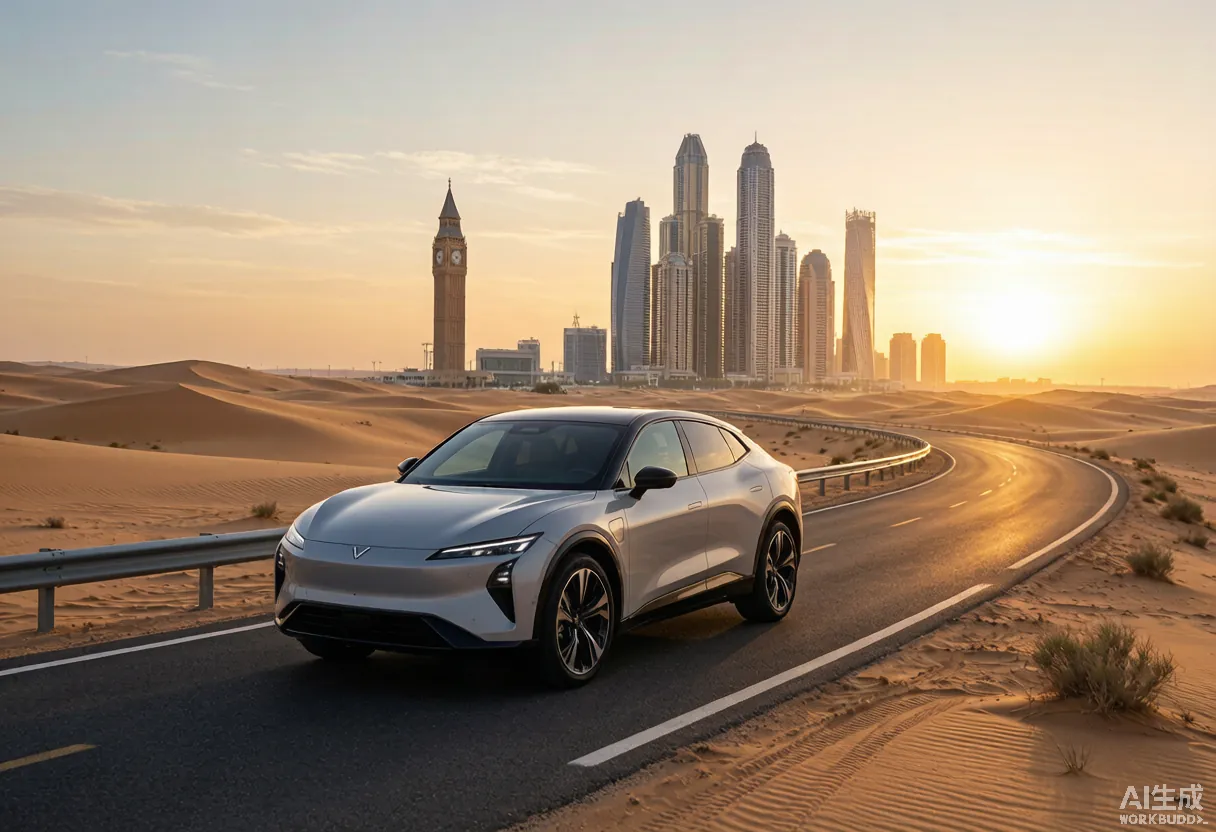
Several Middle Eastern countries adjusted their vehicle import policies in 2026, and the overall direction remains friendly to Chinese NEVs. The UAE's 2026 budget confirmed the continued GCC unified 5% import tariff (including EVs), with no anti-dumping duty on China and only an additional 5% federal VAT. Saudi Arabia has made NEVs central to its "Vision 2030," planning $39 billion in investment with a target for EVs to account for at least 30% of Riyadh's vehicles by 2030, and charging stations expanding from about 200 to 5,000 — infrastructure first, paving the way for EV volume. At the policy level, Gulf states are proactively opening their doors to Chinese NEVs, in stark contrast to the trade barriers in European and American markets. This sustained policy friendliness also lowers Chinese automakers' hesitation about local investment; cooperation models such as local assembly and co-built channels are being implemented faster, giving importers a wider range of roles in the division of labor.
Jordan completed a structural tax overhaul in June 2026: the special rate for EVs was unified at 27%, gasoline vehicles fell from 71% to 51%, and hybrids from 60% to 39%, while imports of EVs older than 3 years are now banned — further widening the total-cost-of-ownership advantage of EVs. The UAE's "Green Mobility 2030" program plans 42,000 charging piles; NEVs already exceeded 25% of vehicle sales in 2024, the highest in the Middle East. Public acceptance of EVs in the UAE is at the region's highest level, market-education costs have fallen sharply, and terminal demand is shifting from trial purchases to essential needs, with repeat and upgrade purchases beginning to release. The market keeps expanding — EVs in the Middle East have grown from a niche novelty into a mass consumer product, and channel operators' willingness to stock has clearly strengthened.
One thing to note: entering the Gulf market still requires GCC certification (including 82 safety and emission tests), layered with access procedures such as SASO and SABER. Certification for a single model can exceed RMB 1 million — completing the certification in advance is the key to seizing the window. At the same time, the Middle East's high-temperature environment places higher demands on battery thermal management and air-conditioning performance. Model selection should account for destination-climate suitability to avoid after-sales problems from "unfitted vehicles." Sand and high heat also affect component life, so the local supply capability for after-sales spare parts is worth evaluating in advance.
Taken together, three forces — continued low tariffs, charging infrastructure expansion, and rising household acceptance of new energy — are stacking in favor of Chinese EV brands (BYD, Zeekr and others have already set up local after-sales) during a rare window in the Middle East, especially for SUVs and commercial vehicles. Saudi and UAE government procurement and taxi electrification plans also open up the possibility of bulk orders; importers should watch official tenders and fleet procurement opportunities, build local channels and compliance qualifications early, and seize the first-mover position in the window. In addition, the wealthy segment's preference for premium NEVs provides Chinese brands with a rare testing ground and endorsement effect for premiumization abroad, with significantly higher gross margins on premium models than in mainstream markets.
EZ Auto can screen models that have passed local certification and can be delivered quickly for your Middle East target country, and help calculate tariffs, certification, and logistics costs. Contact us on WhatsApp for specific sourcing and quotes.
What certifications are required to import used cars from China?
Requirements vary by destination (e.g. EAEU needs SBKTS/OTTC, GCC for the Middle East). EZ Auto handles compliant documents and certification per the destination customs, confirming clearance before shipment to avoid port hold-ups.
What recent policy changes affect Chinese vehicle exports?
EV subsidies are phasing out while export licensing and shipping capacity fluctuate. EZ Auto tracks destination tariffs and certification changes and updates them in the News section for procurement decisions.
Can an individual buy a car directly from China for export?
Possible, but with document and customs hurdles. Most buyers order through a licensed exporter like EZ Auto, which handles the contract, export declaration and destination paperwork; you only handle pickup and local registration.
What export documents are needed for used cars?
Core documents include the commercial invoice, packing list, export customs declaration, bill of lading and the destination's import clearance papers. EZ Auto prepares the full set before shipment to ensure smooth clearance abroad and avoid demurrage.
Do destination countries limit the age of imported vehicles?
New cars are mostly unrestricted; used cars often face an age cap (e.g. some Middle East and Africa markets require within 5-8 years). EZ Auto checks the destination's age rule before shipping and screens out non-compliant units to avoid rejection at port.
This article is published by EZ Auto. EZ Auto (Cheyixing Automobile Import & Export) specializes in exporting Chinese vehicles — new, used and parts — serving Latin America, Central Asia & CIS, Africa, the Middle East and the EU, with order-based sourcing, inspection with photo report, export documentation and ocean freight in one place.
Message us on WhatsApp for the latest prices and delivery to your country.
WhatsApp us