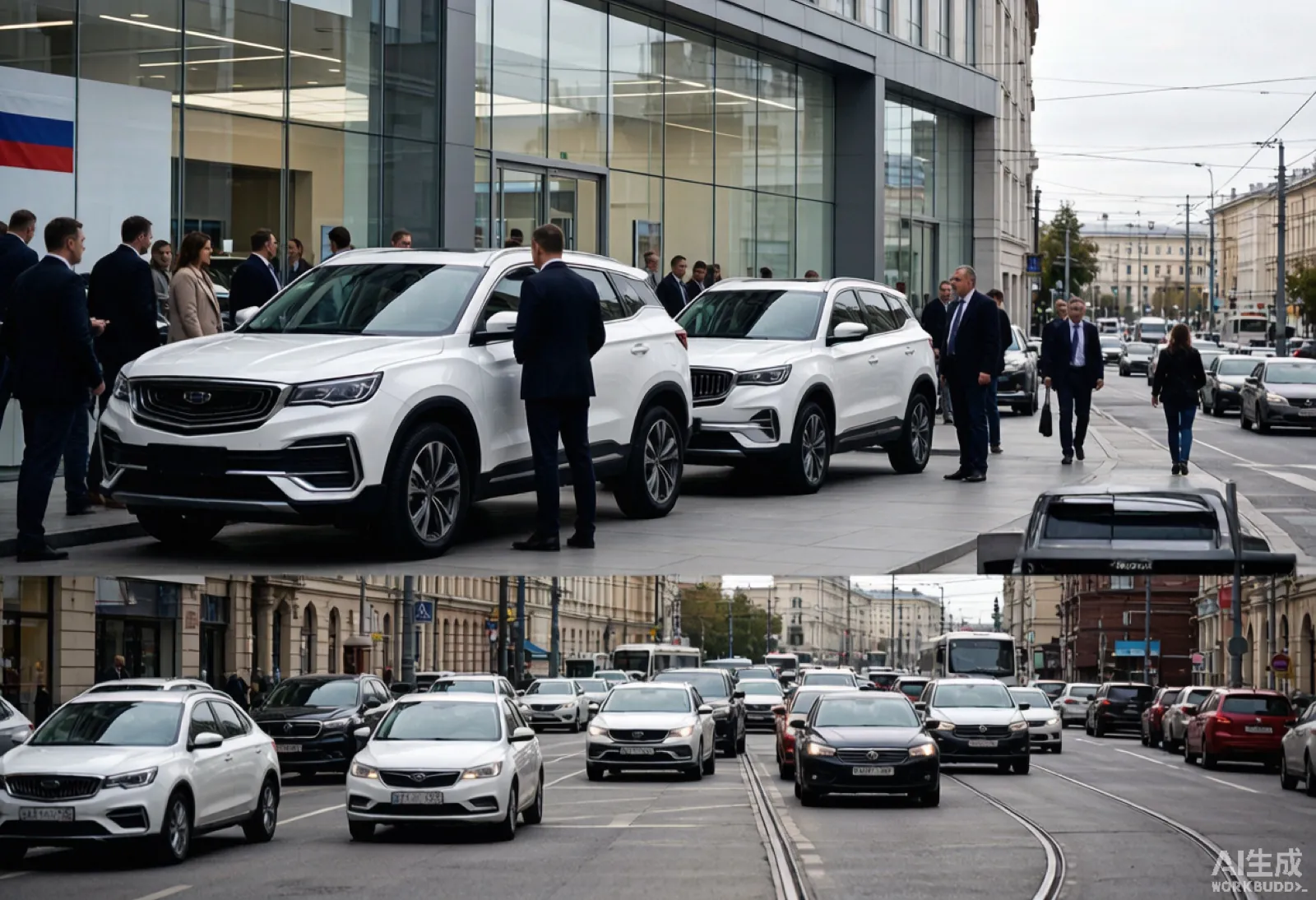
On August 4, Cui Dongshu, secretary-general of the CPCA (China Passenger Car Association), released an analysis of the Russian auto market: new-vehicle sales in Russia reached 122,000 units in June 2026, up 22% year on year; cumulative first-half sales stood at 660,000 units, up 10%. Chinese self-owned brands took a 54.9% share of the Russian market in June — their peak for the year — meaning one in every two new cars sold in Russia now comes from a Chinese automaker.
Behind the high market share lies a sharply shifting policy environment. From 2026, Russia raised its VAT rate from 20% to 22% and the scrappage fee to roughly 800,000-900,000 rubles; the taxi localization law that took effect on March 1 requires commercial vehicles to earn no fewer than 3,200 localization points, with foreign complete vehicles barred from market entry. In May, the Russian president signed a decree extending the special investment contract for GWM (Great Wall Motor)'s plant to the end of 2033, signaling encouragement for Chinese automakers to take root long-term. Overall, the core logic of Russia's policy package is to restrict complete-vehicle imports and steer Chinese automakers toward local manufacturing.
On the import-export front, China exported 84,400 vehicles to Russia in June, while Chinese self-owned brands sold 67,000 locally; in the first half, China exported 448,000 vehicles to Russia against 360,000 local sales by Chinese self-owned brands — local sales equal to about 81% of exports, keeping supply and demand relatively balanced. By brand, Chery maintained sales of nearly 20,000 units a month, Geely and its Zeekr brand grew strongly, and BAIC and others performed notably; in the new-energy segment, Changan, Zeekr and Voyah are the strongest, with extended-range and plug-in hybrid models effectively filling the gap left by the withdrawal of European and American luxury brands. Chinese automakers are responding through KD assembly, regional production bases, parts center warehouses and other means, with the localization rate of core components already raised above 60%. Cui Dongshu also noted that Russia has included Chinese-made premium fuel vehicles and EVs in its luxury-vehicle taxation list, covering models priced above 10 million rubles, further raising the entry threshold for high-end models.
For importers, the Russian market has decisively ended the era of easy gains from complete-vehicle exports; technology transfer and local assembly have become the path to survival for all brands. This means the profit margin on pure vehicle resale is further compressed, and importers' role is shifting from "buying complete vehicles" to "joining the localized supply chain." Companies that have secured OEM authorization or local assembly partnerships will clearly benefit, while purely trading intermediaries face pressure to exit the market. At the same time, high taxes raise per-vehicle costs, the move upmarket continues, and low-priced volume models lose competitiveness.
Importers should now focus on four priorities: first, track the fine print of the scrappage fee, VAT and the 160-horsepower power tiering, and avoid high-tax models when selecting vehicles; second, confirm with domestic OEMs the feasibility of localization cooperation in Russia (KD assembly, contract manufacturing) and pursue official authorized dealership status — brands such as Li Auto have already begun setting up official dealership models in Russia; third, build up certification and compliance capabilities in advance to meet requirements such as OTTC certification with local laboratories and ERA-GLONASS; fourth, design ruble settlement and exchange-rate hedging plans to prevent currency volatility from eroding profits. In addition, it is advisable to lock in cooperation with Russian customs brokers and certification bodies early, avoid vehicles being stranded at port by prolonged certification lead times, and include tax-adjustment clauses in contracts to share policy risk with downstream customers.
What certifications are required to import used cars from China?
Requirements vary by destination (e.g. EAEU needs SBKTS/OTTC, GCC for the Middle East). EZ Auto handles compliant documents and certification per the destination customs, confirming clearance before shipment to avoid port hold-ups.
What recent policy changes affect Chinese vehicle exports?
EV subsidies are phasing out while export licensing and shipping capacity fluctuate. EZ Auto tracks destination tariffs and certification changes and updates them in the News section for procurement decisions.
Can an individual buy a car directly from China for export?
Possible, but with document and customs hurdles. Most buyers order through a licensed exporter like EZ Auto, which handles the contract, export declaration and destination paperwork; you only handle pickup and local registration.
What export documents are needed for used cars?
Core documents include the commercial invoice, packing list, export customs declaration, bill of lading and the destination's import clearance papers. EZ Auto prepares the full set before shipment to ensure smooth clearance abroad and avoid demurrage.
Do destination countries limit the age of imported vehicles?
New cars are mostly unrestricted; used cars often face an age cap (e.g. some Middle East and Africa markets require within 5-8 years). EZ Auto checks the destination's age rule before shipping and screens out non-compliant units to avoid rejection at port.
This article is published by EZ Auto. EZ Auto (Cheyixing Automobile Import & Export) specializes in exporting Chinese vehicles — new, used and parts — serving Latin America, Central Asia & CIS, Africa, the Middle East and the EU, with order-based sourcing, inspection with photo report, export documentation and ocean freight in one place.
Message us on WhatsApp for the latest prices and delivery to your country.
WhatsApp us