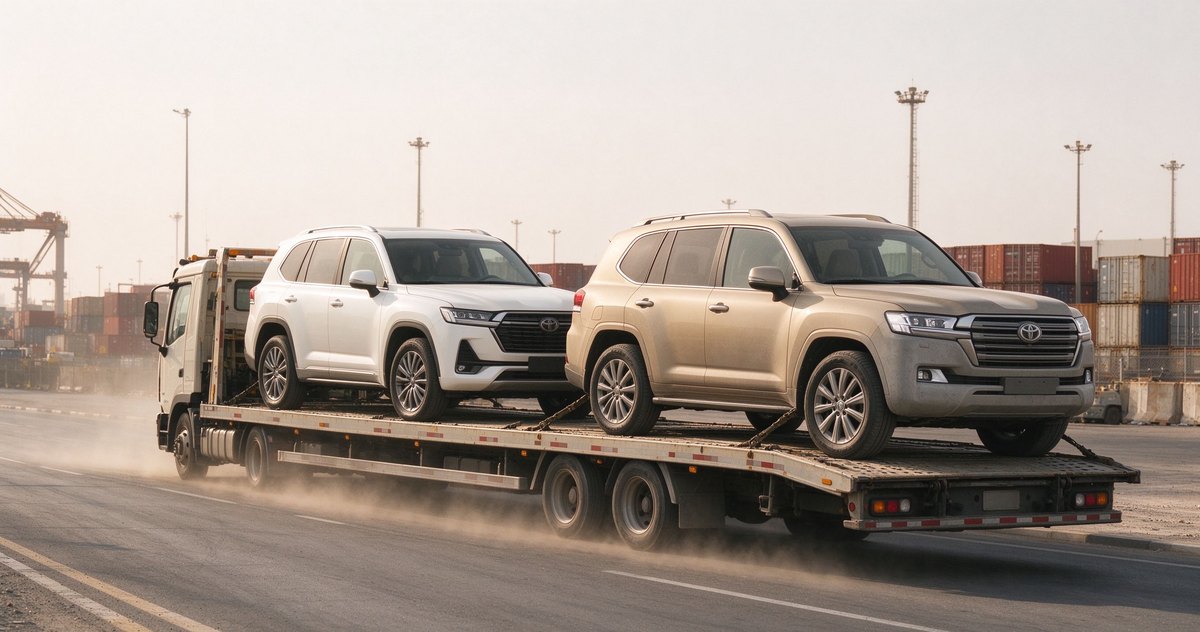
Clients often ask whether a pickup can be exported as a truck, with a lower duty. The question is the wrong way round. A pickup first has to land in 8703 or 8704 before any duty rate means anything, and classification does not turn on whether it has a cargo box.
8703 covers vehicles designed mainly to carry people; 8704 covers goods vehicles. Pickups, double-cab light trucks and vans straddle both headings. The WCO adopted the revised notes to 87.03 and 87.04 at its 28th session in 2001, published them in 2002, and the current version still follows them. The notes describe design features, not appearances.
The three tests can reach different answers on the same vehicle: a long-wheelbase pickup with a short bed may fall under 8703 by the EU length ratio and under 8704 by the Chinese weight ratio. That is not a broker's mistake; it is a difference in method. Put a line in the contract: the heading is subject to the destination customs ruling, and state who bears the duty difference if classification changes.
Light trucks are less contentious: a single cab, no rear seats, a separate cargo box and an obvious goods-carrying design are treated as 8704. The ones that need measuring are double-cab light trucks and pickups converted into SUVs — more seats in the first case, more passenger fittings in the second, and the answer can flip either way.
Nigeria has a directly citable example: section 38 of the Finance Act 2020 cut the 8704 tariff from 35% to 10% and the 8703 levy from 30% to 5%. The two headings have never shared one rate structure; classification changes landed cost directly.
Ghana, per the GRA and ICUMS tariff compilation (public reading, subject to the current tariff): pickups pay about 5% duty as goods vehicles, while petrol passenger cars of the same displacement pay 10%–20%. One band apart, and the duty differs two to four times.
Saudi Arabia and Jordan: we found no official page giving a separate classification guideline for pickups under 8703 or 8704. For those two markets, work from the current tariff and the broker's opinion; do not carry over the Nigerian or Ghanaian conclusion.
For the tax layer, our articles "How is the tariff on used cars in Nigeria calculated? 2026 rates item by item" and "How much tax does importing a Chinese car into Ghana cost? 2026 rates and clearance" already break it down. One line here: classification drives the duty band, so fix the heading before costing. You can start with the site's import duty calculator (/en/duty-calculator), but the heading you select there must match the broker's.
 Can you train our technicians to repair the cars?Method yes, authority no. Service standards, fault diagnosis, lifting and disassembly, torque values and PDI can be taug
 Is it hard to repair a Chinese car in Africa?The hard part is not the repair but finding a licensed workshop and waiting for dedicated parts. Kenya requires a KG lic
 How do you lock an exchange rate, and who carries it?An exchange rate is not a market question but a sharing question. Only three wordings work: fixed rate, band, or a split
 Which clauses must a purchase contract get right?A contract is not a filled-in template. The CISG does not apply automatically in Nigeria, Kenya, Ghana, Tanzania or Sene
 The car has arrived — how do you register it? What paperwork is neededRegistration is not the last step; it is the acceptance check on duty, admission and local inspection. Ghana's DVLA, Ken
Message us on WhatsApp for the latest prices and delivery to your country.
WhatsApp us