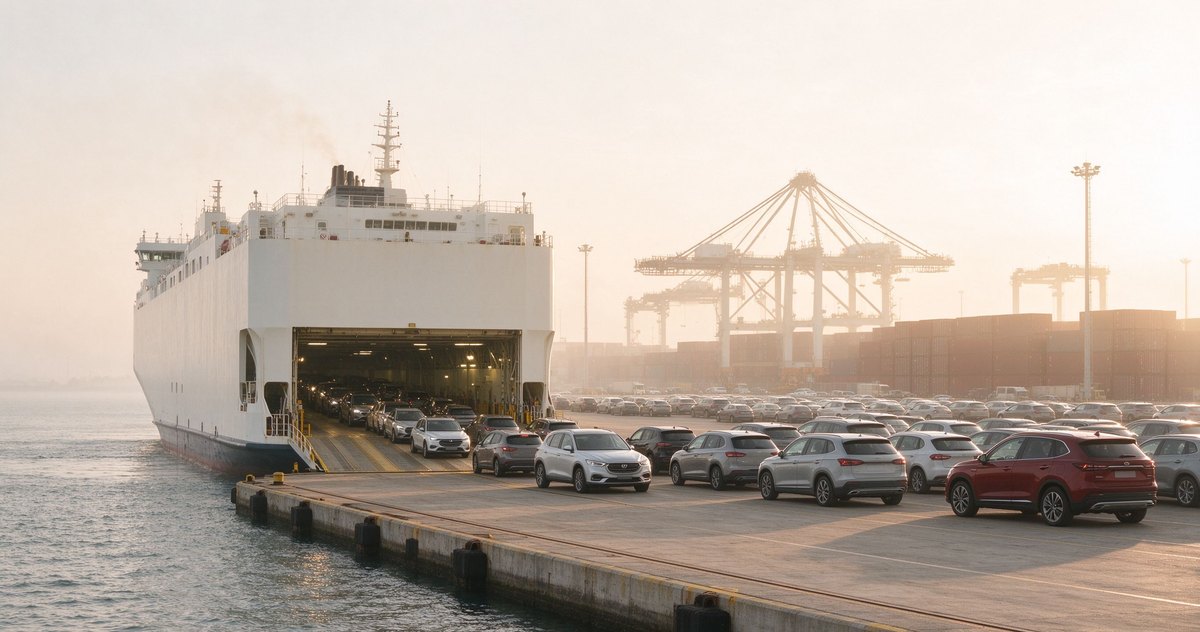
One car at CIF 10000 USD, quoted to a client in Dakar and to one in Dubai, can land more than 30% apart (same size, same age: Senegal 48.563% against the UAE 10.25%, and a different basis widens it further). Most people reach for the tariff first, but lay both schedules side by side and duty is often one line among several. Three things decide the gap: which value the tax is charged on, what the tax is stacked on, and whether customs accepts your invoice.
Senegal's dutiable value is the vehicle plus freight plus other costs, that is CIF. Freight is not taken as paid: a floor table applies, 833 USD for a five-seat passenger car shipped from Asia, 1083 USD for seven seats, 833 USD for a light commercial. Pay less and the floor is used. Cheap cars suffer most: a 6000 USD car with 400 USD of freight still enters the base at 833.
Côte d'Ivoire takes another route: the basis is set by the RFCV issued before declaration, not by the invoice, which counts only as a reference.
The UAE is the shallowest: duty on CIF, VAT on CIF plus duty, two layers and no more.
The same 18% VAT behaves differently depending on whether duty sits inside its base. Senegal's VAT base includes duty and the statistical tax, but not the solidarity levy or the ECOWAS levy; the registration duty then stacks on a base that already includes VAT, at 3% for a used car and 2% for a new one.
The 8703 lines in Côte d'Ivoire carry six entries: duty 20, VAT 18, PCC 0.5, PCS 0.8, PUA 0.2, other 1. Added straight they give 40.3 percentage points, and that figure is only an order of magnitude: VAT at 18% is charged on a base that already includes duty, so the effective multiple runs higher than 40.3. Quote by multiplying layer by layer, not by adding.
Jordan does it differently. Since June 2025 duty, general sales tax and special tax are merged into one total rate, 51% for petrol, 39% for hybrid, 27% for electric, applied directly to the customs assessed value. So Jordan cannot be rebuilt from duty plus sales tax: the two are no longer collected separately.
For used cars Senegal takes the higher of the invoice and the Argus quote, less 20% when Argus is higher. Cars that have dropped out of Argus take the higher of the invoice and the last Argus quote. Recent cars not yet in Argus are depreciated off the new-car export list price: 5% at one month, 15% at two, 20% at three, then 1% a month, capped at 75%.
Côte d'Ivoire uses SYDAM Auto valuation before declaration. Jordan assesses on a government guide price by year, model and engine size. None of the three looks at the price you agreed; under-invoicing has no room at this layer and turns into a penalty at inspection.
Duty accounts for only 500 of that difference; the rest comes from the VAT stacking and the registration duty. That is where a low tariff and an expensive landing come from the same car. Quote by multiplying in order, and do not compare two countries by their headline percentages.
One car's landed price differs on three points: basis, order, valuation. Settle those before discussing rates. For a rough figure, run the CIF through the duty calculator on this site and enter each layer.
 Can you train our technicians to repair the cars?Method yes, authority no. Service standards, fault diagnosis, lifting and disassembly, torque values and PDI can be taug
 Is it hard to repair a Chinese car in Africa?The hard part is not the repair but finding a licensed workshop and waiting for dedicated parts. Kenya requires a KG lic
 How do you lock an exchange rate, and who carries it?An exchange rate is not a market question but a sharing question. Only three wordings work: fixed rate, band, or a split
 Which clauses must a purchase contract get right?A contract is not a filled-in template. The CISG does not apply automatically in Nigeria, Kenya, Ghana, Tanzania or Sene
 The car has arrived — how do you register it? What paperwork is neededRegistration is not the last step; it is the acceptance check on duty, admission and local inspection. Ghana's DVLA, Ken
Message us on WhatsApp for the latest prices and delivery to your country.
WhatsApp us